


vergehen
to pass
The passing of time. Describes the unstoppable progression of minutes, days, or years.
EXAMPLE
Die Jahre sind wie im Flug vergangen.
The years have passed as if they flew by.
to pass / fade
Loading your saved state.
to pass
The passing of time. Describes the unstoppable progression of minutes, days, or years.
Die Jahre sind wie im Flug vergangen.
The years have passed as if they flew by.

to fade / pass
To lessen, stop, or disappear. Often refers to feelings, pain, or conditions.
Der Schmerz im Bein wird bald wieder vergehen.
The pain in my leg will soon pass again.

to assault someone
To sexually abuse or assault someone. This is a serious crime.
Der Täter wurde verurteilt, weil er sich an einer wehrlosen Person vergangen hatte.
The perpetrator was convicted because he had assaulted a defenseless person.
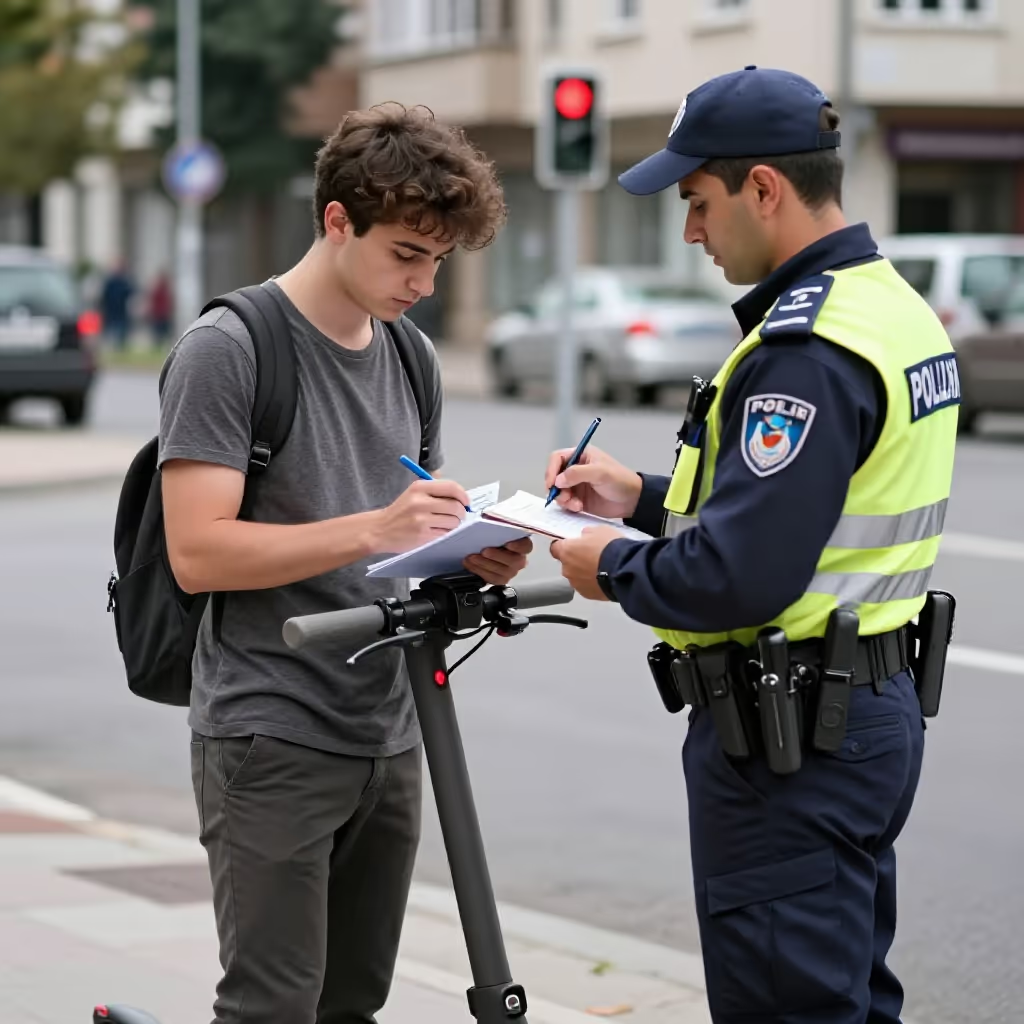
to commit an offense
In the legal sense, to commit a minor criminal offense or an administrative offense.
Wer sich im Straßenverkehr vergeht, muss mit einem Bußgeld rechnen.
Anyone who commits a traffic offense must expect a fine.
'Vergehen' (to pass/fade) is an inseparable verb. The prefix 'ver-' always stays attached to the stem 'gehen' (to go) and often indicates that something disappears, comes to an end, or takes a negative turn.
Ich hoffe, der Schmerz vergeht bald.
I hope the pain passes soon.
To form the past tense with the present perfect, 'vergehen' (to pass/fade) is always used with the auxiliary verb 'sein' (to be), because it describes a change or movement. Using 'haben' (to have) is a common mistake.
Die Zeit ist so schnell vergangen.
Time has passed so quickly.
Pay attention to whether the verb is reflexive. Without 'sich', 'vergehen' (to pass/fade) usually means the passing of time or the disappearance of a feeling. With 'sich', it describes a negative, often criminal act.
Die Kopfschmerzen vergehen langsam.
The headaches are slowly fading.
In the meaning 'Zeit vergeht' (time passes), the verb is often combined with units of time such as 'Stunden' (hours), 'Wochen' (weeks), or 'Jahre' (years). A very common idiom is 'wie im Flug vergehen' (to fly by).
Der Urlaub ist leider wie im Flug vergangen.
Unfortunately, the vacation flew by.
In this serious meaning, the structure is fixed: 'sich an jemandem vergehen' (to assault someone). The preposition 'an' always requires the dative here.
Es ist ein Verbrechen, sich an Kindern zu vergehen.
It is a crime to assault children.
to fly
Both words can describe time passing quickly. „Vergehen“ refers neutrally to the passage of time, while „fliegen“ is colloquial and emphasizes how unusually quickly it passes. Use „vergehen“ for a factual statement and „fliegen“ when the speed is especially noticeable.

Die Ferien vergehen auch dann, wenn man nur zu Hause bleibt.
The holidays pass even if you stay home the whole time.
Die Ferien fliegen vorbei, wenn man jeden Tag etwas Schönes unternimmt.
The holidays fly by when you do something enjoyable every day.