


rangehen
to answer
Colloquial for answering a phone call.
EXAMPLE
Das Telefon klingelt ununterbrochen, aber niemand will rangehen.
The phone keeps ringing, but nobody wants to answer it.
to answer / approach
Loading your saved state.
to answer
Colloquial for answering a phone call.
Das Telefon klingelt ununterbrochen, aber niemand will rangehen.
The phone keeps ringing, but nobody wants to answer it.

to approach
To begin a task, problem, or piece of work; to tackle something.
Wir müssen strategisch an die Planung des neuen Projekts rangehen.
We need to approach the planning of the new project strategically.

to go up to
To physically approach a person or object.
Geh nicht so nah an den Hund ran, er ist fremden gegenüber sehr scheu.
Don't go so close up to the dog; he is very shy around strangers.
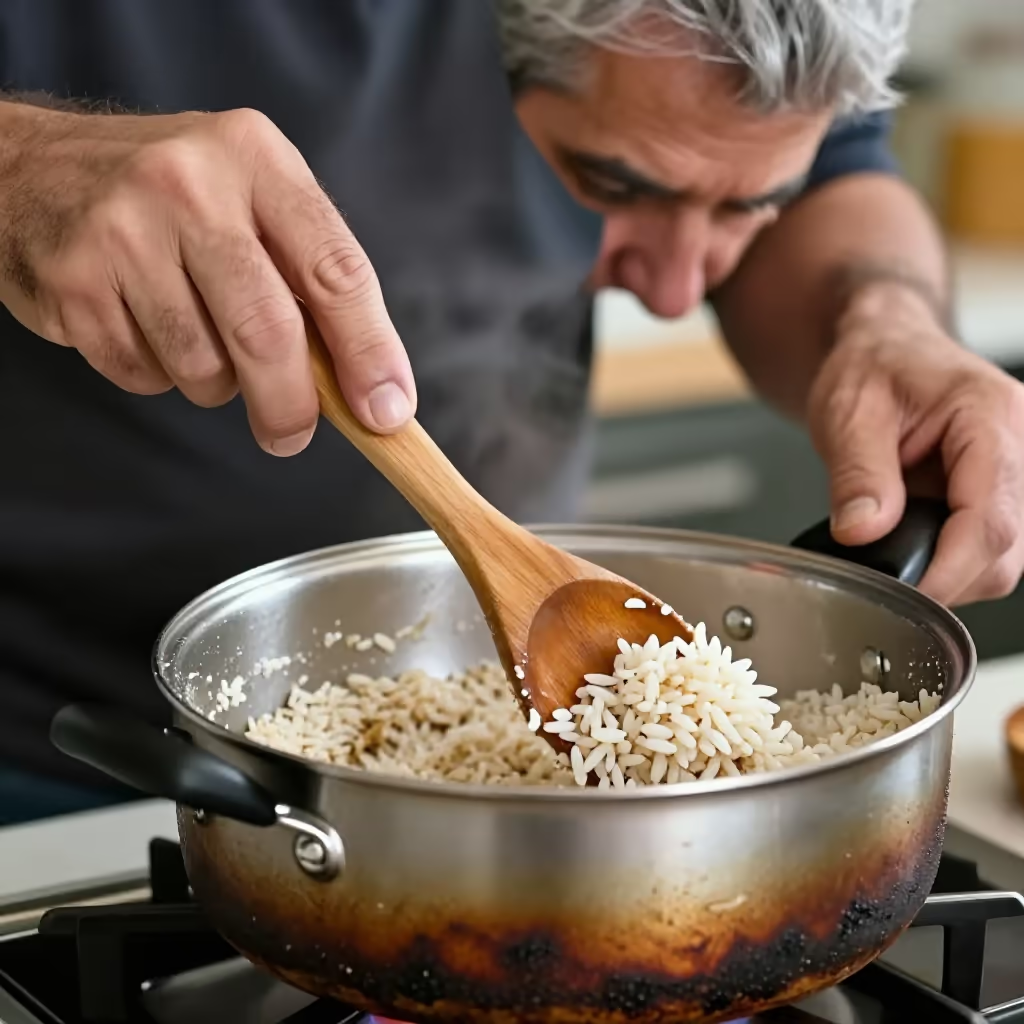
to stick
When cooking, to stick to the bottom of a pot or pan and burn slightly.
Pass auf, dass der Milchreis nicht rangeht, du musst ständig rühren.
Be careful that the rice pudding doesn't stick; you have to stir constantly.
'Rangehen' is a separable verb with the prefix 'ran-'. In a main clause, the prefix stands at the end. In subordinate clauses and in the infinitive with 'zu', the verb stays together.
Das Telefon klingelt, geh doch mal ran!
The phone is ringing; go answer it!
The prefix 'ran' is a colloquial short form of 'heran'. It always expresses movement or approach toward something or someone. This basic idea appears in all meanings.
Lass uns endlich an die Arbeit rangehen.
Let's finally get started on the work.
In the meaning 'einen Anruf annehmen' (to answer a call), 'rangehen' (to answer) is very colloquial. It is used less often in formal or business situations.
Warum gehst du nicht ran? Vielleicht ist es wichtig.
Why don't you answer it? Maybe it's important.
When it is about starting a task or problem, 'rangehen' (to approach/tackle) is almost always used with the preposition 'an' and the accusative.
Wir müssen systematisch an dieses Problem rangehen.
We need to approach this problem systematically.
This meaning is used exclusively in the context of cooking. The subject of the sentence is always the food that sticks to the bottom of the pot.
Rühr bitte die Soße um, damit sie nicht rangeht.
Please stir the sauce so it doesn't stick.
to begin / to start
Both words can express that you are beginning a task. “Anfangen” describes the beginning neutrally, whereas “rangehen” is colloquial and emphasizes actively taking on and working on the task. Use “rangehen” when the meaning involves not only the start but also the practical engagement with the task.

Ich gehe jetzt an die schwierige Aufgabe ran.
I’m tackling the difficult task now.
Ich fange jetzt mit der Aufgabe an.
I’m starting the task now.