


schlecht
bad
Of low quality, not meeting expectations, or faulty.
EXAMPLE
Der Film hatte eine schlechte Bewertung und hat mir auch nicht gefallen.
The film had a bad review, and I didn't like it either.
bad
Loading your saved state.
bad
Of low quality, not meeting expectations, or faulty.
Der Film hatte eine schlechte Bewertung und hat mir auch nicht gefallen.
The film had a bad review, and I didn't like it either.

sick
Feeling unwell or ill. Often in the phrase 'jemandem ist schlecht' (someone feels sick).
Nach der Karussellfahrt war mir furchtbar schlecht.
After the carousel ride, I felt terribly sick.

bad
Morally reprehensible, evil, or indecent.
Es ist eine schlechte Angewohnheit, über andere zu lästern.
It is a bad habit to gossip about others.

bad
Unfavorable or disadvantageous. Often refers to conditions such as weather or light.
Bei schlechtem Wetter fällt das Picknick aus.
In bad weather, the picnic is canceled.
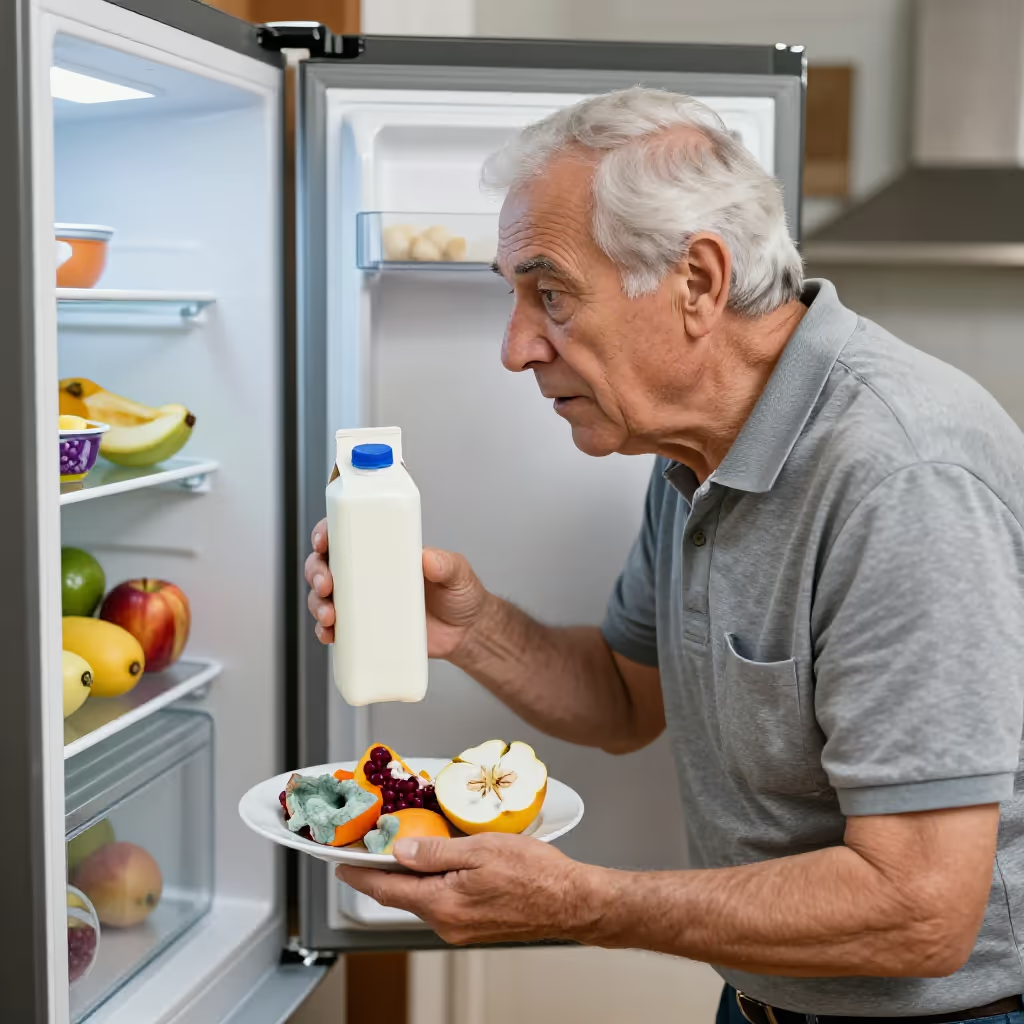
bad
Refers to food that is spoiled and no longer edible.
Der Joghurt riecht komisch, ich glaube, er ist schlecht.
The yogurt smells strange; I think it's bad.

badly
Used as an adverb to describe the poor performance of an activity; insufficiently, incorrectly.
Ich habe heute Nacht sehr schlecht geschlafen.
I slept very badly last night.
To say that you feel unwell or nauseous, you use the dative construction 'Mir ist schlecht' (I feel sick). The sentence 'Ich bin schlecht' means 'I am a bad person' and is a very common mistake.
Ich glaube, ich habe etwas Falsches gegessen, mir ist schlecht.
I think I ate something bad; I feel sick.
'Schlecht' (bad/badly) can be an adjective that describes a noun or an adverb that describes a verb. In German, the word has the same form in both cases when it comes after the verb.
Das ist ein schlechter Witz. (Adjektiv)
That is a bad joke. (Adjective)
The adjective 'schlecht' (bad) is the basis for the verb 'sich verschlechtern' (to get worse), which means 'schlechter werden' (to become worse). It describes a negative process.
Sein Gesundheitszustand hat sich über Nacht verschlechtert.
His state of health worsened overnight.
In the meaning 'of low quality', 'schlecht' (bad) is often combined with nouns like 'Qualität' (quality), 'Arbeit' (work), 'Leistung' (performance), or 'Note' (grade).
Für diese schlechte Arbeit bekommst du kein Geld.
You won't get any money for this bad work.
To describe unfavorable circumstances, 'schlecht' (bad) is often used with 'Wetter' (weather), 'Licht' (light), or 'Zeiten' (times).
Bei dem schlechten Licht kann ich kaum lesen.
In this bad light, I can hardly read.
When 'schlecht' (bad) is used in connection with food or drink, it almost always means 'spoiled'. It is often combined with the verbs 'sein' (to be) or 'werden' (to become).
Die Milch riecht komisch, ich glaube, sie ist schlecht geworden.
The milk smells strange; I think it has gone bad.
bad / serious
Schlecht primarily evaluates the poor quality or condition of something. Schlimm, on the other hand, emphasizes how serious, burdensome, or consequential something negative is. Depending on the perspective, both words can describe the same situation.

Nach dem Sturm ist das Dach in einem schlechten Zustand.
After the storm, the roof is in poor condition.
Nach dem Sturm ist der Schaden am Dach so schlimm, dass das Haus unbewohnbar ist.
After the storm, the damage to the roof is so severe that the house is uninhabitable.