


sich setzen
to sit down
To take a sitting position.
EXAMPLE
Nach dem langen Spaziergang wollte ich mich nur noch setzen.
After the long walk, I just wanted to sit down.
to set / put
Loading your saved state.
to sit down
To take a sitting position.
Nach dem langen Spaziergang wollte ich mich nur noch setzen.
After the long walk, I just wanted to sit down.

to put
To put, place, or position something in a specific place.
Sie setzte die Vase vorsichtig auf den Tisch.
She carefully put the vase on the table.

to rely on
To place one's trust in someone or something, or to stake a bet on a specific outcome.
Bei diesem Projekt setzen wir voll auf erneuerbare Energien.
For this project, we are relying completely on renewable energy.

to set
To establish or determine something, for example a price, a deadline, or a standard.
Wir müssen eine klare Frist für die Abgabe des Projekts setzen.
We need to set a clear deadline for submitting the project.

to plant
To put plants or seeds into the soil so that they can grow.
Im Frühling setzen wir Kartoffeln im Garten.
In spring, we plant potatoes in the garden.

to put at risk
To risk something valuable, with the possibility of losing it.
Mit dieser unüberlegten Aktion hat er seine ganze Karriere aufs Spiel gesetzt.
With this rash action, he put his entire career at risk.
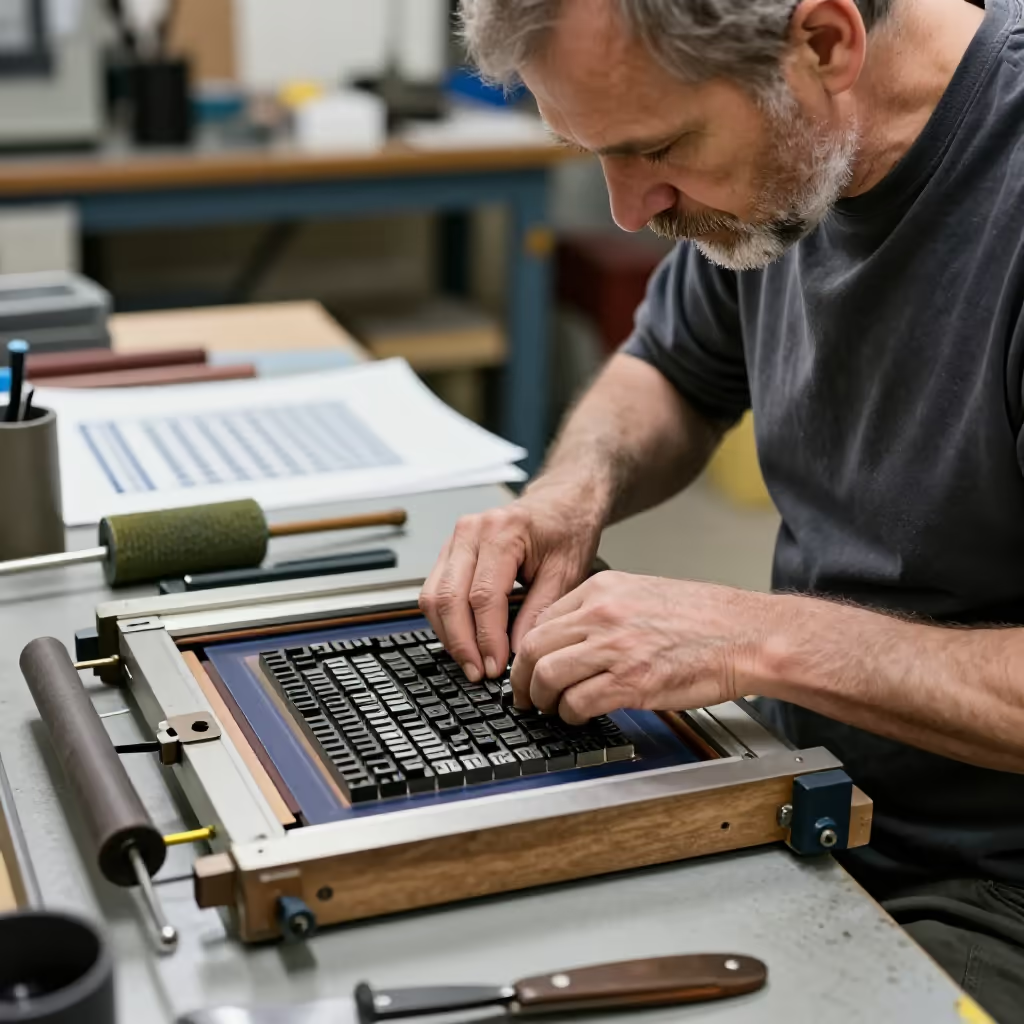
to typeset
In printing, to arrange the letters and characters for printing.
Früher wurde jede Zeitungsseite von einem Schriftsetzer von Hand gesetzt.
In the past, every newspaper page was typeset by hand by a typesetter.
It is important to distinguish between 'sich setzen' (to sit down) and 'etwas setzen' (to put/place something). 'Sich setzen' is reflexive and means that you sit yourself down. 'Etwas setzen' is transitive and means that you place an object somewhere.
Ich setze mich auf den Stuhl.
I sit down on the chair.
'Setzen' is a very productive base verb in German. If you know it, you can understand many other important verbs more easily, for example 'übersetzen' (to translate), 'einsetzen' (to use / insert), 'fortsetzen' (to continue), or 'ersetzen' (to replace).
Der Dolmetscher muss den Satz sofort übersetzen.
The interpreter has to translate the sentence immediately.
When you place something, the verb 'setzen' needs an accusative object (what you are placing) and an indication of direction (where you are placing it). The question is always 'Wohin?' (where to?), so a two-way preposition is used with the accusative.
Er setzte seinen Namen unter den Vertrag.
He put his name under the contract.
In the meaning 'vertrauen auf' (to rely on) or 'wetten auf' (to bet on), 'setzen' is always used with the preposition 'auf' and the accusative.
Ich setze auf den Sieg meiner Lieblingsmannschaft.
I am betting on my favorite team winning.
In the meaning 'festlegen' (to establish/set), 'setzen' is often combined with abstract nouns. Common phrases are 'Grenzen setzen' (to set boundaries), 'Prioritäten setzen' (to set priorities), 'ein Zeichen setzen' (to send a signal), or 'Maßstäbe setzen' (to set standards).
Es ist wichtig, klare Prioritäten für das Projekt zu setzen.
It is important to set clear priorities for the project.
In a gardening context, 'setzen' is used for plants that you put into the soil as a whole or as a tuber/bulb. Typical combinations are 'Kartoffeln setzen' (to plant potatoes), 'Zwiebeln setzen' (to plant onions/bulbs), or 'einen jungen Baum setzen' (to plant a young tree).
Wir haben gestern die Tulpenzwiebeln für das nächste Frühjahr gesetzt.
Yesterday we planted the tulip bulbs for next spring.
The expression 'etwas aufs Spiel setzen' (to put something at risk) is a fixed unit. The thing being risked appears as an accusative object before 'aufs Spiel'.
Er hat seinen Job aufs Spiel gesetzt, um die Wahrheit zu sagen.
He put his job at risk in order to tell the truth.
to put / to set
Stellen means that, when placing something, an object is put into an upright position. Setzen refers more generally to placing something in a specific location and does not clearly specify its orientation. So stellen is more precise for an upright object, although setzen may still be possible.
Setz die Vase bitte vorsichtig auf den freien Platz auf dem Tisch.
Please place the vase carefully in the empty spot on the table.
Stell die Vase bitte aufrecht auf den Tisch.
Please stand the vase upright on the table.