


krachen
to crack
To make a loud, short, and often splintering sound that occurs when hard objects break, collide, or strike something.
EXAMPLE
Plötzlich krachte ein Ast und fiel auf die Straße.
Suddenly, a branch cracked and fell onto the road.
to crash / crack
Loading your saved state.
to crack
To make a loud, short, and often splintering sound that occurs when hard objects break, collide, or strike something.
Plötzlich krachte ein Ast und fiel auf die Straße.
Suddenly, a branch cracked and fell onto the road.
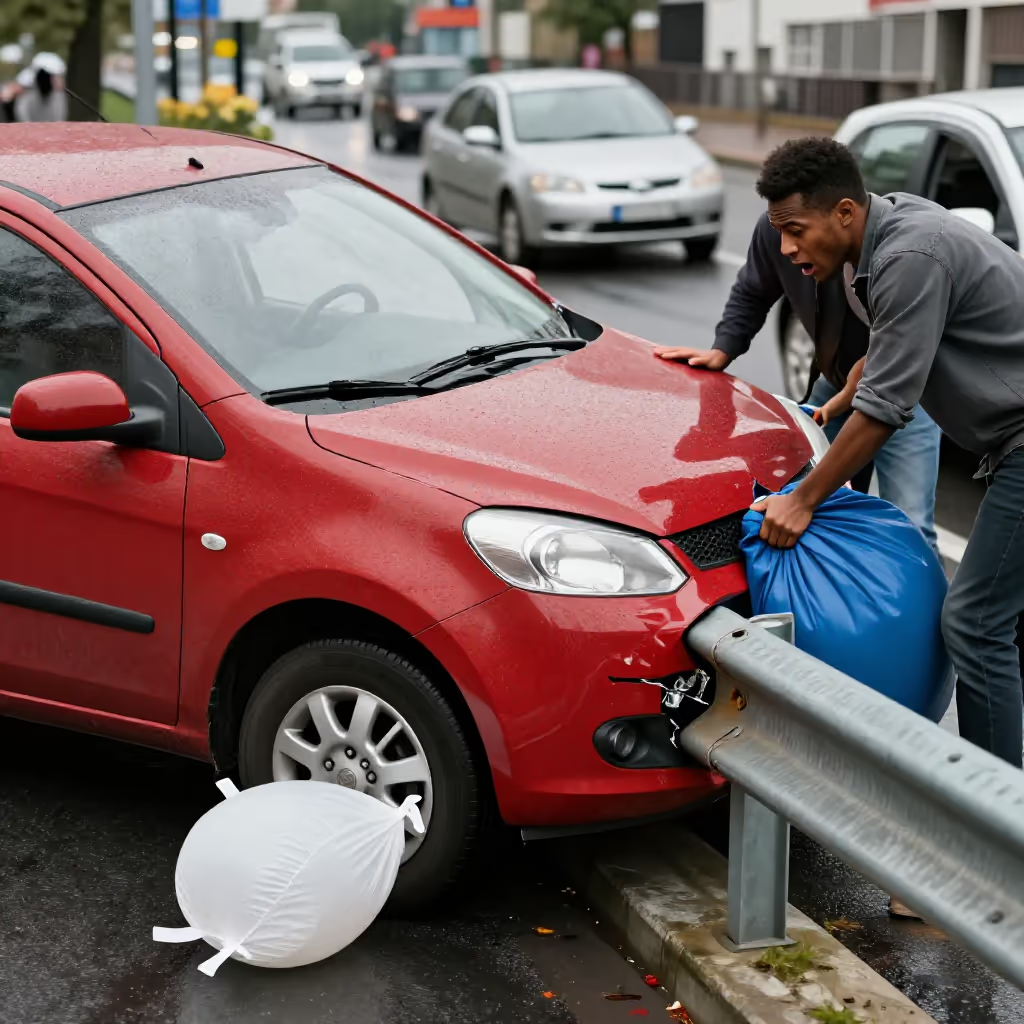
to crash
To hit something at high speed and with force; to have an accident.
Das Auto ist ungebremst gegen die Leitplanke gekracht.
The car crashed into the guardrail without braking.

to party hard
Colloquial for celebrating exuberantly and loudly or throwing a party.
An seinem Geburtstag will er es mal wieder richtig krachen lassen.
For his birthday, he wants to really party hard again.

to clash
Colloquial for having a loud argument or a heated confrontation.
Zwischen den beiden Geschäftsführern hat es in der Sitzung ordentlich gekracht.
The two managing directors really clashed during the meeting.
The perfect tense of 'krachen' (to crash/crack) is formed with 'haben' (to have) or 'sein' (to be). 'Haben' is used when it is only about the sound. 'Sein' is used when movement or an accident is being described.
Der Donner hat laut gekracht.
The thunder cracked loudly.
When 'krachen' (to crash) describes a collision, it is often followed by a preposition that indicates direction. Typical constructions are 'gegen etwas (Akkusativ) krachen' (to crash into something) or 'in etwas (Akkusativ) krachen' (to crash into something).
Der Lastwagen ist gegen einen Baum gekracht.
The truck crashed into a tree.
The colloquial idiom 'es krachen lassen' means 'to party hard' or 'to let loose.' The structure is fixed: a person (subject) 'lässt es krachen' (parties hard/lets loose).
Zu Silvester haben wir es richtig krachen lassen.
On New Year's Eve, we really partied hard.
The meaning 'to argue fiercely' is colloquial. It is often used to describe a conflict between two or more people. Sometimes the preposition 'zwischen' (between) is used.
Gestern hat es zwischen den Nachbarn wieder ordentlich gekracht.
Yesterday, the neighbors clashed again pretty badly.
to bang / slam
Knallen and krachen can both refer to a sudden, loud noise. Knallen is especially suitable for a short, explosive sound, such as a door slamming, while krachen is more suggestive of hard objects, collisions, or splintering sounds. Choose the verb according to the typical source of the noise.
Beim Sturm krachte ein dicker Ast auf das Autodach.
During the storm, a thick branch crashed onto the car roof.
Die Tür knallte zu, als der Wind stärker wurde.
The door slammed shut as the wind grew stronger.