


der Pol
pole
One of the two geographic endpoints of the Earth's axis, that is, the North Pole or the South Pole.
EXAMPLE
Am Nordpol ist es extrem kalt und es gibt Eisbären.
At the North Pole it is extremely cold, and there are polar bears.
pole
der Pol, die Pole
Loading your saved state.
pole
One of the two geographic endpoints of the Earth's axis, that is, the North Pole or the South Pole.
Am Nordpol ist es extrem kalt und es gibt Eisbären.
At the North Pole it is extremely cold, and there are polar bears.
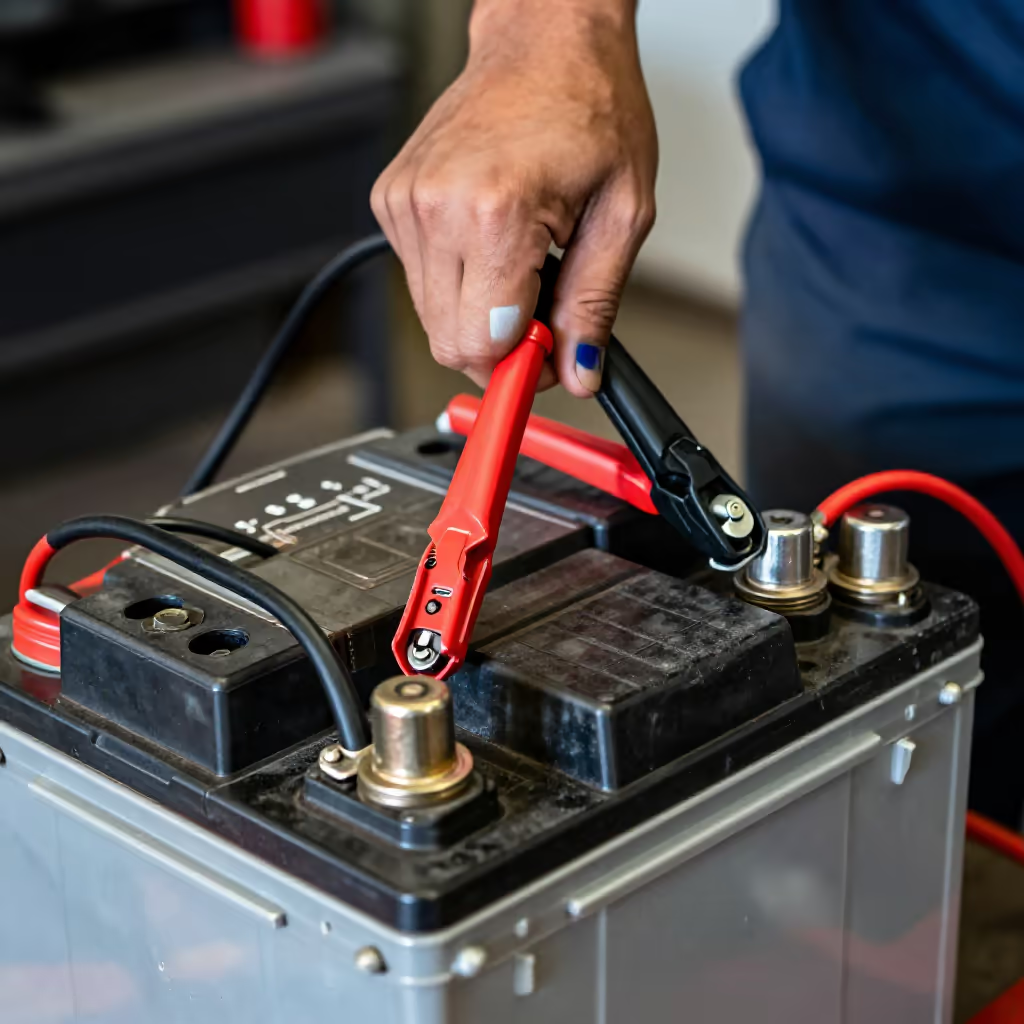
terminal / pole
One of the two connections of an electrical source such as a battery, referred to as the positive terminal (+) or negative terminal (-).
Verbinden Sie das rote Kabel mit dem Pluspol der Batterie.
Connect the red cable to the positive terminal of the battery.

pole / opposite
One of two opposing points, e.g., in a magnet (magnetic pole), or figuratively for extreme opposites in opinions or characters.
In der politischen Debatte bildeten die beiden Redner die entgegengesetzten Pole.
In the political debate, the two speakers represented opposite poles.
| gender | masculine der |
|---|---|
| plural | die Pole |
| genitive | des Pols |
| singular | plural | |
|---|---|---|
| nominative | der Pol | die Pole |
| accusative | den Pol | die Pole |
| dative | dem Pol | den Polen |
| genitive | des Pols | der Pole |
The article changes with the case; it is shown in colour.
The exact meaning of 'Pol' (pole) is almost always made clear by the context or by a compound word. Pay attention to signal words like 'Nord-/Süd-' (north/south, geography), 'Plus-/Minus-' (positive/negative, electricity), or 'Gegensatz' (opposite, figurative).
Das Schiff ist bis zum Nordpol gefahren.
The ship sailed all the way to the North Pole.
Verbinde das Kabel mit dem positiven Pol.
Connect the cable to the positive terminal.
In geography, the poles are almost always referred to as 'Nordpol' (North Pole) or 'Südpol' (South Pole). To describe the location, German uses the preposition 'an' with the dative.
An den Polen der Erde ist es das ganze Jahr über sehr kalt.
At the Earth's poles, it is very cold all year round.
In a figurative sense, 'Pol' (pole) describes an extreme opposite. A common expression is also 'ein ruhender Pol sein' (to be a calm center/steadying presence), which describes a very calm and balancing person in a hectic environment.
In der hitzigen Diskussion vertrat er den entgegengesetzten Pol.
In the heated discussion, he represented the opposite pole.
Inmitten des Chaos blieb sie der ruhende Pol für alle.
In the midst of the chaos, she remained the calm center for everyone.
opposite / contrast
Both words can describe opposing opinions or qualities. „Gegensatz“ refers generally to opposition, whereas „Pol“ highlights one of two usually extreme sides of a spectrum. Use „Gegensatz“ for the contrast and „Pol“ when two opposing endpoints are meant.

Die beiden Meinungen bilden die entgegengesetzten Pole der Debatte.
The two opinions represent the opposing poles of the debate.
Zwischen den beiden Meinungen besteht ein deutlicher Gegensatz.
There is a clear contrast between the two opinions.