

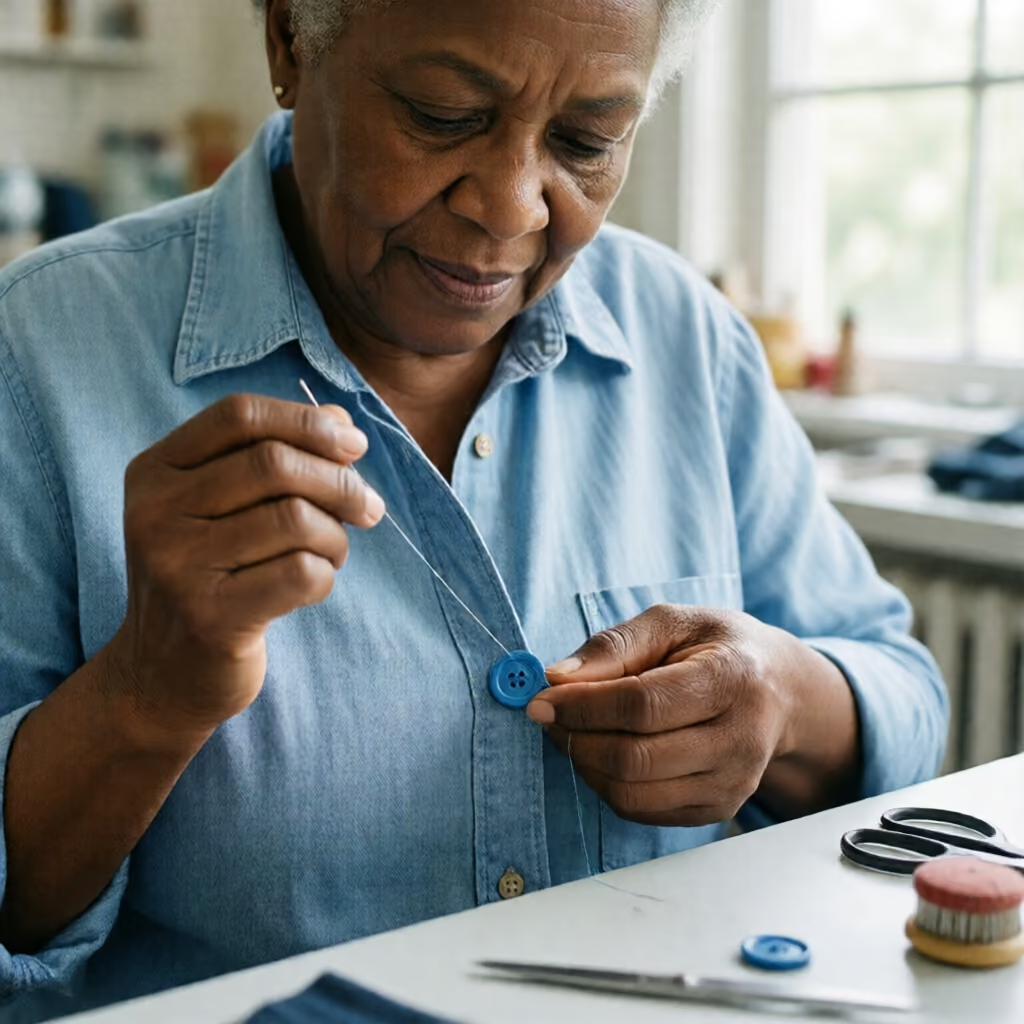
annähen
cucire
Fissare o unire qualcosa a un altro oggetto cucendolo.
ESEMPIO
Ich muss den losen Knopf wieder annähen.
Devo ricucire il bottone che si è staccato.
cucire
annähen – nähte an – hat angenäht
Caricamento dello stato salvato.
cucire
Fissare o unire qualcosa a un altro oggetto cucendolo.
Ich muss den losen Knopf wieder annähen.
Devo ricucire il bottone che si è staccato.
| ich | nähe an |
|---|---|
| du | nähst an |
| er/sie/es | näht an |
| wir | nähen an |
| ihr | näht an |
| sie | nähen an |
| ich | nähte an |
|---|---|
| du | nähtest an |
| er/sie/es | nähte an |
| wir | nähten an |
| ihr | nähtet an |
| sie | nähten an |
| ich | habe angenäht |
|---|---|
| du | hast angenäht |
| er/sie/es | hat angenäht |
| wir | haben angenäht |
| ihr | habt angenäht |
| sie | haben angenäht |
| du | näh an! nähe an! |
|---|---|
| ihr | näht an! |
| Sie | nähen Sie an! |
| ich | hatte angenäht |
|---|---|
| du | hattest angenäht |
| er/sie/es | hatte angenäht |
| wir | hatten angenäht |
| ihr | hattet angenäht |
| sie | hatten angenäht |
| ich | werde annähen |
|---|---|
| du | wirst annähen |
| er/sie/es | wird annähen |
| wir | werden annähen |
| ihr | werdet annähen |
| sie | werden annähen |
| ich | nähe an |
|---|---|
| du | nähest an |
| er/sie/es | nähe an |
| wir | nähen an |
| ihr | nähet an |
| sie | nähen an |
Si usa per il discorso indiretto.
| ich | nähte an |
|---|---|
| du | nähtest an |
| er/sie/es | nähte an |
| wir | nähten an |
| ihr | nähtet an |
| sie | nähten an |
Si usa per i desideri e per il “würde”.
| infinito | annähen |
|---|---|
| con zu | anzunähen |
| Partizip I | annähend |
| Partizip II | angenäht |
«Annähen» (cucire sopra o attaccare cucendo) è formato dal prefisso «an-» (che indica l'attaccamento) e dal verbo «nähen» (cucire) ed è separabile. Nella proposizione principale «an» (la particella separabile) si trova alla fine della frase; nella proposizione subordinata il verbo resta unito. Nell'infinito con «zu» (la particella dell'infinito), «zu» si trova tra il prefisso e il verbo.
Sie näht den Knopf wieder an.
Lei ricuce di nuovo il bottone.
Ich hoffe, dass sie den Knopf annäht.
Spero che lei ricucia il bottone.
Der Knopf ist leicht anzunähen.
Il bottone è facile da ricucire.
Con «annähen» (cucire sopra o attaccare cucendo), di solito si indica prima ciò che viene fissato e poi, con «an» (a), l'oggetto a cui viene fissato. L'oggetto dopo «an» si trova di solito all'Akkusativ.
Sie näht einen Flicken an die Hose an.
Lei cuce una toppa sui pantaloni.
Le espressioni frequenti con «annähen» (cucire sopra o attaccare cucendo) sono «einen Knopf annähen» (cucire un bottone), «einen Flicken annähen» (cucire una toppa) e «einen Aufnäher annähen» (cucire una toppa decorativa). Di solito si parla di piccoli pezzi di stoffa o di capi d'abbigliamento.
Vor dem Fest näht er noch einen Aufnäher an seine Jacke an.
Prima della festa, lui cuce ancora una toppa decorativa sulla sua giacca.