

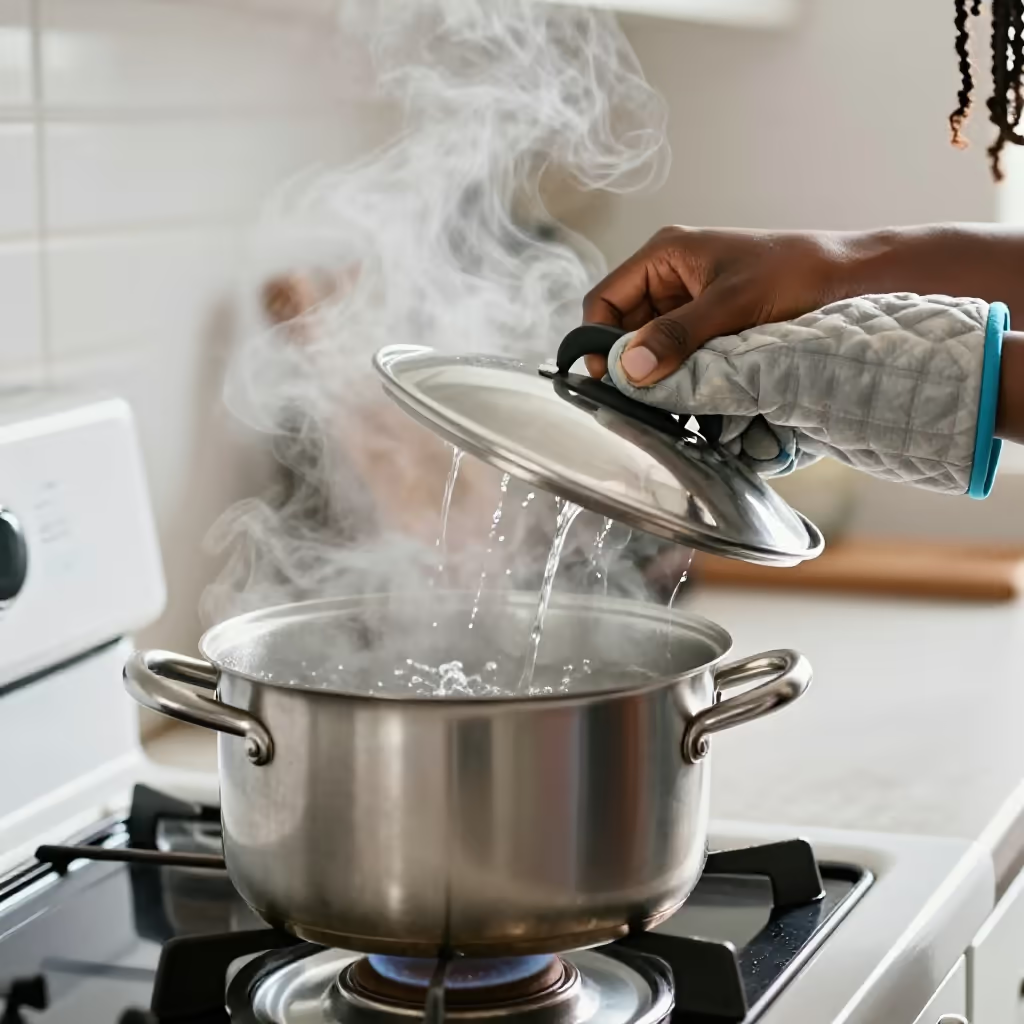
verdampfen
to evaporate
The transition of a liquid into a gaseous state, usually by heating it to the boiling point.
EXAMPLE
Wenn man Wasser lange genug kocht, verdampft es vollständig.
If you boil water long enough, it evaporates completely.
to evaporate / vanish
Loading your saved state.
to evaporate
The transition of a liquid into a gaseous state, usually by heating it to the boiling point.
Wenn man Wasser lange genug kocht, verdampft es vollständig.
If you boil water long enough, it evaporates completely.

to vanish
Colloquial for disappearing quickly and unnoticed; to make oneself scarce.
Als die Polizei kam, hatte sich der Dieb längst verdampft.
When the police arrived, the thief had long since vanished.
The verb is derived from the noun 'der Dampf' (steam/vapor). The prefix 'ver-' here describes the process of transformation, so 'zu Dampf werden' (to become vapor).
Durch die Hitze der Sonne verdampft das Wasser auf der Straße.
The heat of the sun makes the water on the street evaporate.
'Verdampfen' (to evaporate) is an inseparable verb. The prefix 'ver-' always stays at the beginning of the verb, even in a main clause and in the past participle.
Das Lösungsmittel verdampft sehr schnell an der Luft.
The solvent evaporates very quickly in the air.
Since 'verdampfen' (to evaporate) describes a change of state from liquid to gaseous, the perfect tense is formed with the auxiliary verb 'sein' (to be).
Das ganze Wasser in der Schale ist über Nacht verdampft.
All the water in the bowl evaporated overnight.
In the colloquial meaning 'verschwinden' (to disappear), the verb is always used reflexively: 'sich verdampfen' (to vanish). It expresses that someone leaves quickly and secretly.
Nach der peinlichen Frage hat er sich einfach verdampft.
After the embarrassing question, he simply vanished.